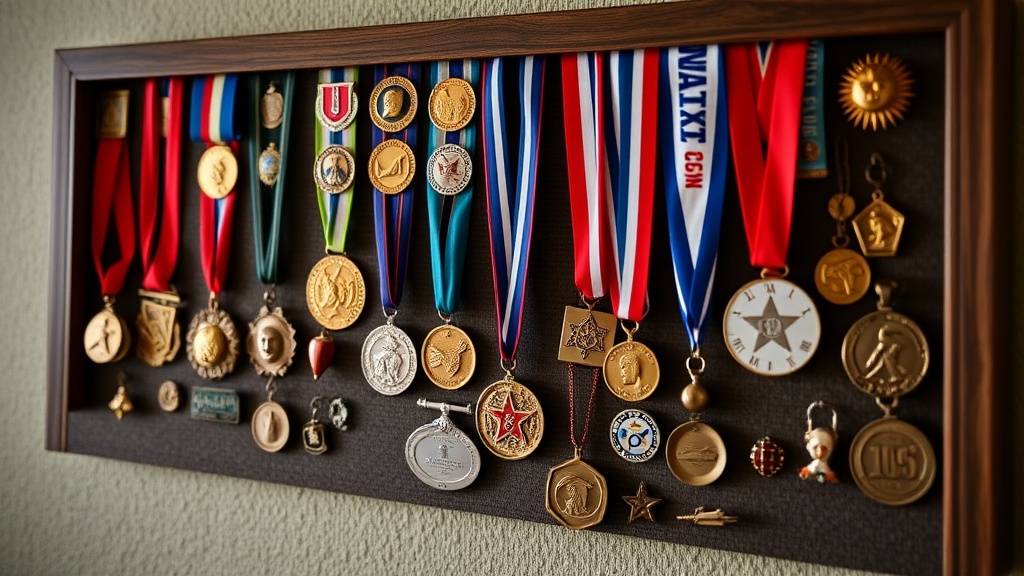
5 Creative Ways to Display Your Medal and Pin Collection

Shadow Box Frames with Felt Backing
Cork Board with Custom Fabric Cover
Acrylic Display Cases with UV Protection
Vintage Drawer Pull Display Boards
Rotating Display Stands for Pins
How medals and pins get displayed directly impacts how often they're enjoyed, how well they're preserved, and how much space they claim in a home. This post covers five practical, creative methods for showcasing collections of all sizes — from modest sets of running medals to extensive enamel pin boards that spill across entire walls. Whether the goal is protection, aesthetics, or simply getting pieces out of dusty shoeboxes, these approaches balance visual impact with real-world functionality.
What's the Best Way to Display Medals Without Damaging Walls?
The best way to display medals without damaging walls involves using removable mounting solutions, tension-based systems, or freestanding displays that don't require drilling. Command strips, magnetic mounts, and over-the-door hooks all work well for renters or anyone hesitant to put holes in drywall.
Many collectors start by nailing straight into walls — only to regret it later when rearranging. Here's the thing: medals are heavier than they look. A single marathon medal with its ribbon can weigh 3-4 ounces. Multiply that by twenty, and you've got several pounds hanging from a single point.
Removable options worth considering:
- 3M Command Picture Hanging Strips — rated for up to 16 pounds per pair, these work beautifully for lightweight shadow boxes and small displays
- Magnetic knife strips — repurposed from IKEA or OXO Good Grips, these hold pins and small medals securely without any wall penetration
- Over-the-door wreath hangers — doubled up, these can support surprising weight and allow vertical medal hanging on any interior door
For those who prefer freestanding solutions, the Medal Awards Rack standing display holds up to 60 medals without touching a wall. The Container Store's acrylic medal stands offer a cleaner, minimalist aesthetic — perfect for desks or bookshelves.
That said, wall damage isn't the only concern. Sunlight fades ribbons faster than most collectors realize. East-facing windows can bleach red ribbons to pink within two years. Worth noting: position displays away from direct light, or invest in UV-protective acrylic covers.
How Do You Organize a Large Pin Collection for Display?
Large pin collections organize best through categorization systems — by theme, color, acquisition date, or geographic origin — then displayed on surfaces that accommodate rearrangement. Cork boards, magnetic sheets, and fabric-covered foam allow for constant reorganization as collections grow.
The catch? Most collectors don't plan for expansion. A hundred pins feels manageable until it becomes three hundred, then five hundred. Starting with a scalable system prevents the dreaded "drawer of shame" — pins that no longer fit the current display.
Cork board approaches:
Standard office cork boards work for small collections but show wear quickly. Better options include:
- Frame It Easy custom cork boards — available up to 40" x 60" with clean wood frames
- DIY ribbon-wrapped Homasote panels — found at most lumber yards, these dense fiberboards accept pins beautifully and cost roughly $15 for a 4' x 8' sheet
- Shadow box depth matters — pins with posts and clutches need at least 1.5 inches of depth; military challenge coins need 2+ inches
For magnetic organization, galvanized steel sheets from Sheet Metal Plus provide an industrial backdrop that holds magnetic pin backs securely. Spray-painted matte black or wrapped in decorative paper, these disappear behind the collection itself.
Are Shadow Boxes or Open Displays Better for Medal Collections?
Shadow boxes protect medals from dust and damage but limit accessibility and visibility from angles. Open displays offer better viewing and easier handling but require more frequent cleaning and carry higher risk of accidental damage. The choice depends on whether the collection is actively handled or purely admired.
Active competitors — runners, swimmers, martial artists — often prefer open displays. They pull medals down regularly, show them to visitors, rearrange by event date. The tactile connection matters.
Heritage collectors — those displaying grandfather's military decorations or vintage Olympic pins — typically favor protection. These pieces aren't handled; they're preserved.
| Feature | Shadow Boxes | Open Displays |
|---|---|---|
| Dust protection | Excellent — sealed environments | None — requires weekly dusting |
| Visibility | Good from front, limited from sides | 360-degree viewing possible |
| Accessibility | Requires opening, unscrewing, or removing glass | Immediate — grab and go |
| Cost (per piece) | $25-$150 depending on size | $5-$40 for hooks, racks, stands |
| Best for | Vintage, valuable, or fragile items | Active collections, frequent handling |
The Michael's Display Case shadow boxes offer decent quality at budget prices — often 50% off during holiday sales. For premium protection, Gaylord Archival medal cases include acid-free backing and museum-quality glass. Worth the investment for anything pre-1960 or truly irreplaceable.
Can You Display Medals and Pins Together in One Cohesive Arrangement?
Medals and pins display beautifully together when unified through color coordination, thematic grouping, or complementary framing styles. The key is creating visual hierarchy — medals typically anchor as larger elements while pins fill detail spaces around them.
Portland's own Floyd's Coffee Shop on North Williams Avenue demonstrates this masterfully. Their wall features a local runner's marathon medals arranged in chronological order, with enamel pins from each race's expo filling the gaps between ribbons. The result reads as one continuous story rather than two separate collections.
Successful combination strategies:
- Chronological interweaving — pin from the 2019 Boston Marathon positioned beside that year's finisher medal
- Color blocking — all blue-toned medals grouped together, with blue-accented pins creating gradient transitions
- Scale layering — larger medals at eye level, pins clustered in frames or smaller shadow boxes at the arrangement's edges
Here's the thing about combining: the hardware matters more than the items. Mixing pin backs with medal ribbons requires different mounting approaches. Pin backs need firm surfaces; medal ribbons need hooks or draping space. Plan the infrastructure before arranging the collection.
The SteelMaster SoHo Collection literature organizers — normally used for file folders — work surprisingly well for mixed displays. The vertical slots hold medal ribbons; the flat top surface accommodates small pin boards or framed groupings.
What Are Some DIY Display Options for Collectibles on a Budget?
Budget DIY display options include repurposed window frames, thrifted cutlery trays, wooden wine boxes, and homemade cork walls. These approaches typically cost under $30 and allow complete customization of size, color, and layout.
The salvage yards along Southeast Hawthorne Boulevard in Portland regularly yield perfect display materials. Old printer's trays — originally designed for metal type — now sell for $15-40 and provide dozens of perfect pin-sized compartments. Chicken wire frames, reclaimed from torn-down coops, create rustic medal hangers when stapled to painted wood backings.
Three proven DIY approaches:
1. The Repurposed Cutlery Tray
Thrift stores overflow with wooden cutlery organizers. Sand, stain or paint, then mount vertically. Each spoon slot becomes a medal ribbon channel. A $4 tray from Goodwill transforms into a charming 12-medal display. Add small screw hooks to the bottom edge for additional hanging space.
2. The Pallet Wood Ribbon Board
Shipping pallets — free behind most hardware stores — break down into rustic planks. Space them half an inch apart, nail to a backing board, and ribbon medals slip between the gaps. No hooks needed. The natural gaps hold ribbons securely while displaying the full medal face forward.
3. The Embroidery Hoop Pin Cluster
Small enamel pin collections shine in embroidery hoops. Stretch fabric (linen, burlap, or even old concert t-shirts) across the hoop, secure with glue, and pin directly into the fabric. Cluster three hoops of varying sizes for visual interest. Total cost: roughly $8 at Jo-Ann Fabric and Crafts.
That said, DIY doesn't mean disposable. Use acid-free materials when possible — regular cardboard backing will yellow white ribbons within five years. Archival foam board costs only slightly more than standard and preserves integrity for decades.
For pins with rubber or PVC clutches (common in modern enamel pins), consider the clutch type before mounting. Butterfly clutches work on any surface. Rubber clutches need more depth. Pin Locks — small locking pin backs available on Amazon — prevent loss during display handling and are worth the $8 investment for any pin valued over $20.
Display choices ultimately reflect how collectors engage with their pieces. Some arrange by emotion — the Boston medal beside the photo taken at Heartbreak Hill. Others organize by aesthetics, creating wall art from color gradients. There's no universal right approach, only the method that keeps the collection visible, protected, and meaningful. Start with what fits the space and budget. Rearrange as the collection evolves. The best display is the one that gets the medals out of the drawer and into daily view — where the memories attached to each piece remain alive and accessible.