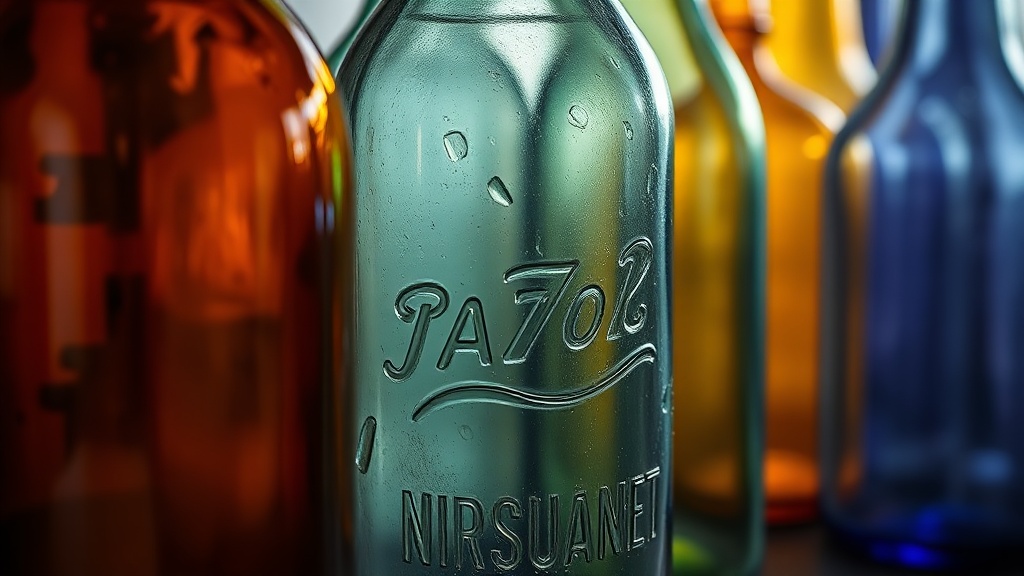
Identifying Real Vintage Glass Bottle Colors and Textures

A Single Drop of Color Can Change Everything
Did you know that during the mid-19th century, the chemical composition of glass was often a byproduct of the raw materials available in a specific region? A single impurity in the sand or a slight variation in the furnace temperature could turn a standard clear bottle into a rare, deep emerald or a striking cobalt blue. Understanding these nuances isn't just about aesthetics; it's about distinguishing a common relic from a piece of history. This guide covers the physical markers—color, texture, and imperfections—that define genuine vintage glass bottles.
When you're holding a piece of hand-blown glass, the weight and the way light hits the surface tell a story. Modern glass is often too perfect, too uniform. Vintage pieces, however, carry the "fingerprints" of their creation. Whether it's a swirl of an air bubble or a slight irregularity in the base, these aren't defects—they're evidence of authenticity. If you're looking to build a collection of apothecary or soda bottles, knowing what to look for prevents you from overpaying for mass-produced modern replicas.
How Do I Spot Authentic Hand-Blown Glass?
The first thing to look for is the presence of "seeds." These are tiny air bubbles trapped within the glass during the blowing process. While modern manufacturing has largely eliminated these, they are a hallmark of older, hand-worked pieces. You might also see striations—long, thin lines that run through the body of the glass—which occur when the glass is being shaped or manipulated while molten.
Look closely at the rim (the finish). In older glass, the rim was often finished by hand, leading to slight asymmetries. If the rim is perfectly circular and mathematically precise, you're likely looking at a machine-made piece from the 20th century. To understand more about the evolution of glass manufacturing, the Smithsonian Institution provides incredible resources on the history of industrial glass. A truly vintage bottle will rarely feel "sterile" or perfectly smooth; it should have a certain character that reflects its manual origins.
Why Is the Color of My Bottle So Irregular?
Color variation is one of the most common points of confusion for new collectors. In many cases, the color isn't uniform throughout the entire vessel. You might see a bottle that is deep amber at the base but fades to a pale yellow at the neck. This is often due to the way the glass was cooled or the uneven distribution of metal oxides used for coloring. In the 1800s, additives like iron (for green/amber) or cobalt (for blue) were added to the molten glass, and these ingredients didn't always mix perfectly.
This lack of uniformity is a good sign. For example, if you see a "sun-bleached" effect where one side of the bottle is lighter than the other, it might indicate the bottle was stored in a window or under direct sunlight for decades. This level of physical aging is hard to fake. If you want to research specific pigment-related historical data, checking the archives at Library of Congress can offer insight into the industrial standards of different eras. A solid, monochromatic color across a modern machine-made bottle is a signal that the piece lacks the organic history found in older specimens.
Can I Use Chemical Tests to Identify Glass?
While you shouldn't be running chemical tests on your collection at home, it's helpful to know that the chemistry of the glass itself is a major identifier. For instance, "Flint Glass" is a high-quality, clear glass that was popular for much of the 19th century. It lacks the greenish tint found in cheaper soda-lime glass. If you see a bottle that appears clear but has a slight yellowish tint under a UV light, it may be a sign of a specific type of older soda-lime glass rather than a modern high-clarity soda-lime.
| Feature | Vintage (Hand-Blown/Early Machine) | Modern (Mass-Produced) |
|---|---|---|
| Bubbles | Frequent "seeds" or large bubbles | Rare or non-existent |
| Rim/Finish | Asymmetrical, hand-finished | Perfectly circular, machine-cut |
| Color | Variable, organic, sometimes streaked | Uniform, consistent, predictable |
| Surface | May have ripples or striations | Smooth, flawless surface |
One way to check the age of a bottle without specialized tools is to examine the base. Many older bottles have a "pontil mark." This is a rough, scarred area on the bottom where a metal rod (the pontil) was detached from the glass after it was blown. It's a blunt, unpolished mark that proves the piece was hand-finished. If the base is perfectly smooth and even, it was likely produced on a modern conveyor belt. This distinction is vital for anyone trying to avoid the many high-quality reproductions currently flooding the market.
Always remember that collecting is about more than just the object; it's about the history the object carries. A bottle with a slightly uneven wall or a curious tint isn't "damaged" in the eyes of a collector—it's a witness to the era in which it was made. Keep an eye out for these small details, as they are the keys to a truly authentic collection.