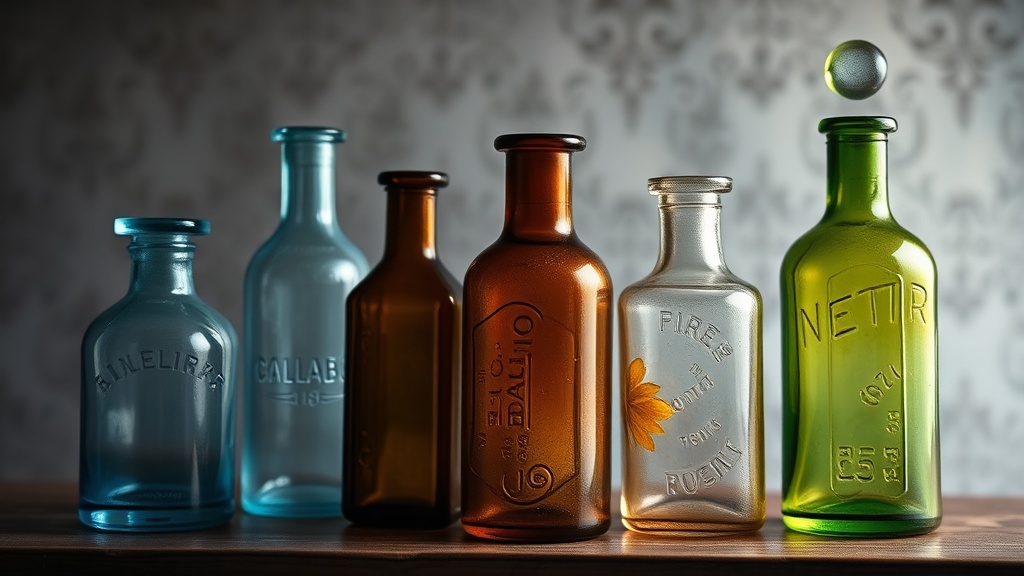
Victorian Glass Medicine Bottles: Seven Distinctive Markers of Rarity

"Wait, isn't that just a broken piece of glass?" That's usually the reaction when I show off a bottle with a rough, jagged circle on the bottom. Most folks think a smooth, polished base is the sign of quality—but in the world of 19th-century smalls, that jagged scar is exactly what you want to see. It's a common misconception that "perfect" glass is old glass. In reality, the primitive nature of early American and European glass production is what gives these pieces their soul. This post covers the specific manufacturing markers that separate a common dug bottle from a museum-grade find, and why those little medicine jars in your attic might be worth a lot more than you think.
How can you tell if an old bottle is hand-blown?
One of the fastest ways to check age is to look at the side seams. If you see a seam that runs all the way from the base and over the very top of the lip, you're likely holding something machine-made after 1900. Before the Owens automatic bottle machine changed everything, glass was a labor-intensive craft. On older bottles, those side seams will usually disappear somewhere around the shoulder or partway up the neck. That's because the "lip" or "finish" was added by hand using a separate tool once the bottle was removed from the mold. You'll often see a slight difference in the glass texture where the mold seam ends and the hand-finished neck begins (it's often smoother or has horizontal tool marks).
Then there's the pontil scar. When a glassblower took the hot bottle out of the mold, they'd attach a solid iron rod (a pontil) to the bottom so they could finish the top. When they snapped that rod off, it left a mark. An "open pontil" looks like a rough, circular break that can be quite sharp. A "sand pontil" has bits of iron or glass debris embedded in the base. These marks are like a fingerprint from the mid-1800s. If your bottle has a perfectly smooth, indented base without any scarring, it's likely a later piece from the late 19th century or early 20th century. For a deep dive into dating these markings, the Society for Historical Archaeology has the most exhaustive database available.
Why are cobalt blue poison bottles so collectible?
It wasn't about aesthetics. In the Victorian era, lighting was poor and literacy wasn't universal. If you were reaching for a bottle of medicine in a dimly lit room at 2 AM, you didn't want to accidentally grab a bottle of laudanum or arsenic. The solution was tactile. Poison bottles were specifically designed to feel "scary" or "different" in the hand. That deep cobalt blue (and sometimes emerald green) was a visual warning, but the physical ridges, bumps, and "hobnails" on the glass were the real lifesavers.
Many of these "smalls" feature diamond patterns or vertical ribs that make them impossible to mistake for a standard tonic. For collectors, these textures are pure gold. The more aggressive the texture, the better. Some even had "POISON" embossed in large, blocky letters, often vertically. It's a fascinating look at early safety design—a time when the bottle's shape was its own warning label. You can find some incredible examples of these through the Federation of Historical Bottle Collectors, which showcases how varied these safety designs became.
What makes a medicine bottle rare today?
Embossing is usually the deal-breaker. A plain bottle might be worth a few bucks as a window decorator, but if it's embossed with a local pharmacy name or a specific "cure-all" brand, the price jumps. Bitters bottles are the heavy hitters in this category. During the 19th century, "bitters" were sold as medicine but were often just flavored alcohol (which helped people get around strict temperance laws). Bottles shaped like log cabins, fish, or even cannons are incredibly sought after because they represent a specific moment in medical (and social) history.
1. The Applied Lip
If you look closely at the top of a pre-1880 bottle, you might see a slight ring of glass that looks like it was "smeared" on. That's because it was. The glassblower literally took a glob of molten glass and wrapped it around the neck, then shaped it with a finishing tool. It's often slightly crooked or has "stretch marks." This is a huge marker for age and adds a level of character that modern glass just can't replicate. It's a messy, beautiful sign of human labor.
2. Seeds and Bubbles
Modern glass is flawless, but 19th-century glass is full of "seeds" (tiny bubbles) and "whittling." Whittling refers to the wavy, textured surface of the glass caused by a cold mold. These aren't defects; they're chronological markers. If the glass looks too clean, be wary. True Victorian glass has an organic, almost liquid quality to it that looks different under every light source.
3. Sick Glass and Iridescence
You'll often hear collectors talk about "sick glass." This happens when a bottle has been buried in the ground for a century and the minerals in the soil react with the glass. It creates a cloudy, milky, or sometimes rainbow-like iridescence. While some purists want crystal-clear glass, others love that "dug" look. It's proof of the object's history—it spent eighty years in a privy pit or a town dump before being rediscovered. Just don't try to scrub it off with harsh chemicals; you'll ruin the very patina that tells its story.
4. The Black Glass Myth
There's also a common myth about "black glass." If you see a bottle that looks pitch black, hold it up to a very strong light. Usually, you'll see it's actually a very deep, dark olive green or amber. This "black" glass was incredibly thick and durable, often used for ale or heavy medicine. It's some of the toughest glass you'll find, and because of the high iron and impurities, it's remarkably heavy for its size. These are often the oldest bottles you'll find in a dig, sometimes dating back to the early 1800s.
5. Local Pharmacy Embossing
National brands like "Mrs. Winslow's Soothing Syrup" are common, but a bottle from a tiny, one-street town in Oregon or Maine is a different story. Local bottles tell the history of a specific community. They were made in small batches, meaning fewer survived. If you find a bottle with a city name you recognize, hold onto it. Those are the pieces that community museums and local collectors will fight over at auction.
6. Bimal vs. ABM
These are the acronyms you'll hear in the field. BIMAL stands for "Blown In Mold, Applied Lip," while ABM stands for "Automatic Bottle Machine." Knowing the difference is how you spot a $50 bottle from a $0.50 bottle at a garage sale. BIMAL is where the value usually stays. The irregularity of the glass thickness—where one side might be twice as thick as the other—is a classic BIMAL trait that adds to the charm of these small collectibles.
7. Miniature Tinctures
Don't ignore the tiny stuff. Some of the most valuable bottles are barely two inches tall. These were for concentrated oils, perfumes, or potent tinctures. Because they're so small, they were easily lost or broken, making intact examples from the 1850s quite rare. They're perfect for shelf displays since they don't take up much room, but they pack just as much history as a gallon jug. Often, these miniatures were blown into "cup molds" which give them a distinctively crisp base compared to their larger cousins.