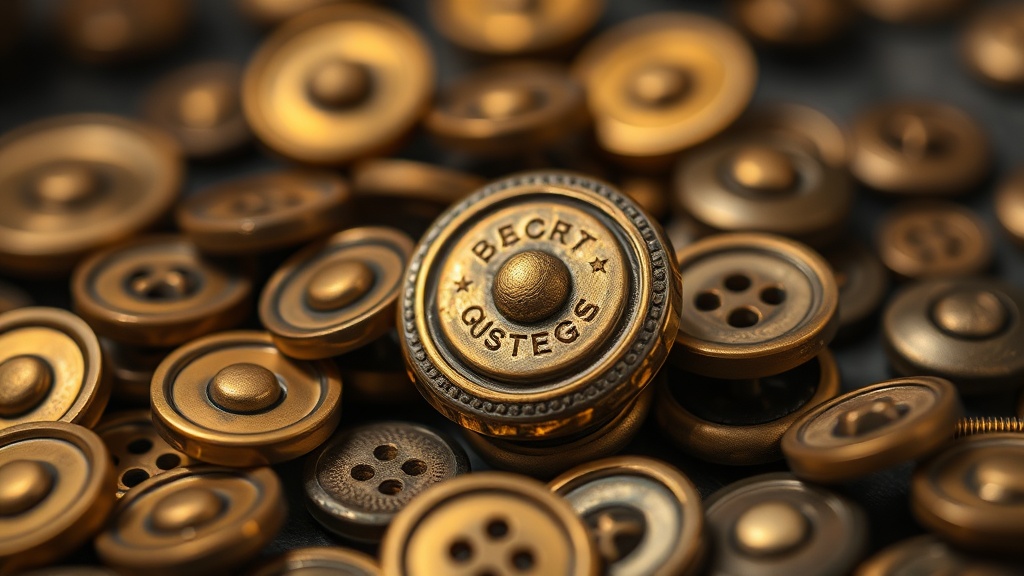
What Separates Ordinary Brass Buttons from Collector-Grade Treasures?

This guide shows you exactly how to identify military and civilian brass buttons that collectors actually want—covering construction details, backmark analysis, patina patterns, and the subtle flaws that separate museum-quality pieces from common hardware. You will learn to spot the difference between a 50-cent button and one worth fifty dollars without relying on guesswork.
How Can You Tell If a Brass Button Is Actually Vintage?
The weight hits your palm first. Genuine vintage brass buttons—whether from military uniforms, livery coats, or workwear—carry a heft that modern zinc alloy reproductions simply cannot fake. Pick one up and you will feel it immediately. The metal feels dense, substantial, almost eager to sink into your hand rather than sit lightly on top.
Now flip it over. The back tells almost everything worth knowing. Vintage brass buttons feature shanks (those loops on the reverse) that were soldered or integral-cast with the main body—not glued, not clipped, not snapped on. Run your fingernail across where the shank meets the button face. On authentic pieces, you will find a smooth transition or a slightly irregular solder line. Modern fakes almost always show a mechanical attachment point, a visible seam, or worse—a plastic component disguised with metallic paint.
Backmarks matter enormously. American military buttons from the Civil War through World War I typically bear maker stamps on the reverse—companies like Scovill, Steele & Johnson, or Horstmann. These were not decorative choices. Manufacturers marked their work because government contracts required accountability, and because reputation meant everything in an era when a failed button could cost someone their coat in a rainstorm. The National Park Service maintains excellent archives of these maker marks for comparison.
European buttons follow similar logic but different patterns. British regimental buttons often display the maker name around the rim rather than centrally, and French military pieces frequently include a date letter system that corresponds to specific production years. Learning these regional quirks takes time—but recognizing that such systems exist separates the knowledgeable collector from someone buying pretty metal disks.
What Patina Patterns Reveal About a Button's History?
New collectors often reach immediately for polish. Resist this urge. The surface oxidation on vintage brass buttons contains information that no catalog or reference book can replace—information that vanishes forever beneath Brasso and elbow grease.
Authentic patina develops unevenly. You will see darker tones in recessed areas where fingers rarely touched, lighter highlights on raised surfaces where natural oils and friction created a gentle polish over decades. This variation creates visual depth that chemical aging cannot replicate convincingly. Fake patina—often applied with acids, ammonia fumes, or buried burial techniques—tends toward uniformity. It looks "old" in a general sense but lacks the specific topography of genuine age.
Green verdigris presents a more complicated case. On one hand, copper-based alloys (brass contains copper) naturally develop green corrosion when exposed to moisture and carbon dioxide over centuries. On the other hand, aggressive verdigris often signals poor storage conditions or active deterioration that threatens the metal beneath. The collector wants stable patina—a rich brown-to-black surface that has stopped actively changing. Flaking green crud suggests ongoing chemical reactions that will eventually pit and weaken the button.
Look closely at high points and edges. Genuine vintage buttons show micro-abrasions—tiny scratches, softened corners, a certain mellowness that comes from thousands of tiny contacts with fabric, fingers, and time. Reproductions, even when artificially aged, maintain crisper edges and more uniform surface textures. The difference becomes obvious once you have handled enough authentic pieces to calibrate your eye.
Why Do Some Brass Buttons Command Premium Prices While Others Languish?
Rarity drives value, obviously—but the type of rarity matters enormously. A button from an obscure state militia that existed for only eighteen months during the 1860s carries historical scarcity. A button from a common Union infantry regiment with hundreds of thousands of examples manufactured holds little premium despite comparable age. The market rewards what cannot be easily replaced.
Condition operates on a sliding scale that varies by scarcity. For genuinely rare pieces—Confederate staff officer buttons, early federal eagle designs, certain naval patterns—collectors accept minor flaws that would disqualify common varieties. A bent shank on a rare Confederate button becomes a repairable defect. On a common Scovill infantry button from 1863, the same damage renders the piece essentially worthless. Context determines everything.
Design complexity influences price in predictable ways. Die-struck buttons with intricate eagle motifs, detailed floral borders, or multi-part construction required more manufacturing effort and consequently saw smaller production runs. Livery buttons—those uniform fasteners worn by servants of wealthy households—often display elaborate family crests or heraldic devices that collectors prize for their aesthetic appeal and historical specificity. A button bearing the crest of a documented estate connects to verifiable history in ways that generic military buttons cannot always match. The Metropolitan Museum's button collection illustrates this variety beautifully.
Provenance transforms good buttons into exceptional ones. A documented history—accompanied by letters, estate records, or archaeological context—adds irreplaceable narrative value. The button from a specific battlefield, from a known uniform, from a documented collection with pedigree: these pieces trade at multiples of their anonymous equivalents. Paperwork matters in this hobby perhaps more than in any other collecting category except fine art.
Where Should You Hunt for Quality Brass Buttons?
Estate sales in older neighborhoods—particularly in New England, the Mid-Atlantic, and former military towns—yield consistent results. The key is arriving early and knowing what to ask. Most estate sale companies categorize buttons as "sewing notions" or "costume jewelry," often pricing them in bulk lots without individual examination. Your knowledge becomes leverage here. A ten-dollar box of mixed buttons might contain a single piece worth two hundred dollars to the right buyer.
Metal detectorists represent another significant source. Beach hunters and field searchers regularly unearth brass buttons that have lain underground for a century or more. These pieces require special consideration—the patina will differ from attic-kept examples, and corrosion may require stabilization. However, detectorists often sell at reasonable prices because their investment was time and equipment rather than acquisition cost. Building relationships with local detecting clubs puts you first in line when interesting finds emerge.
Online marketplaces demand caution. eBay and similar platforms host countless reproductions misrepresented as vintage, and even honest sellers often lack the expertise to identify what they hold. Request additional photographs of backs and edges. Ask about provenance—where did this come from? When a seller responds with "I don't know, I bought it at an auction," that uncertainty transfers to you. Good deals exist online, but the ratio of wheat to chaff runs heavily toward chaff. Smithsonian Magazine's coverage of button archaeology provides useful context for what authentic pieces should look like.
Collector shows and militaria fairs offer the best combination of selection and accountability. Dealers who specialize in buttons stake their reputations on authenticity. They will discuss pieces knowledgeably, accept returns if misrepresentation occurs, and often provide documentation. The premium you pay over estate sale prices purchases expertise and recourse—valuable insurance when building a serious collection.
How Do You Store and Display Brass Buttons Without Damaging Them?
Brass buttons hate plastic. Specifically, they hate the off-gassing from certain plastics and foams used in inexpensive storage solutions. That tight-sealed plastic case from the craft store? It will accelerate corrosion by trapping humidity and concentrating acidic vapors. Your buttons deserve better.
Archival-quality materials make the difference. Polyethylene or polyester sleeves (Mylar D, specifically) provide inert protection without chemical interaction. Store buttons individually or in small groups, never crammed together where edges can abrade neighboring pieces. The goal is preventing contact between metal surfaces—brass is softer than many collectors realize, and sharp design elements will scratch each other given opportunity and vibration.
Environmental control matters more for brass than for many collectibles. Ideal relative humidity hovers between 45% and 55%—dry enough to prevent active corrosion, humid enough to avoid desiccation that can cause cracking in older cast pieces. Temperature stability prevents the expansion and contraction cycles that stress soldered shanks over decades. An interior closet, away from exterior walls and HVAC vents, usually provides adequate stability without expensive climate control equipment.
For display, consider the lighting. Ultraviolet radiation degrades patina over time, bleaching the rich browns into pale yellows and eventually destroying the surface character that makes vintage brass appealing. LED lighting solves this problem elegantly—bright enough for viewing, cool enough to avoid heat damage, and UV-free. Position displays away from windows, or use UV-filtering glass if natural light is unavoidable.
Documentation deserves equal attention. Photograph acquisitions immediately, record provenance information before memories fade, and maintain a simple database of what you own. This discipline transforms a hoard into a collection—organized, purposeful, and ready for whatever the future brings. Whether you collect for investment, historical interest, or pure aesthetic appreciation, the records you keep today become the story your collection tells tomorrow.